We Built Our Houses to Say 'Go Away' — And It Worked
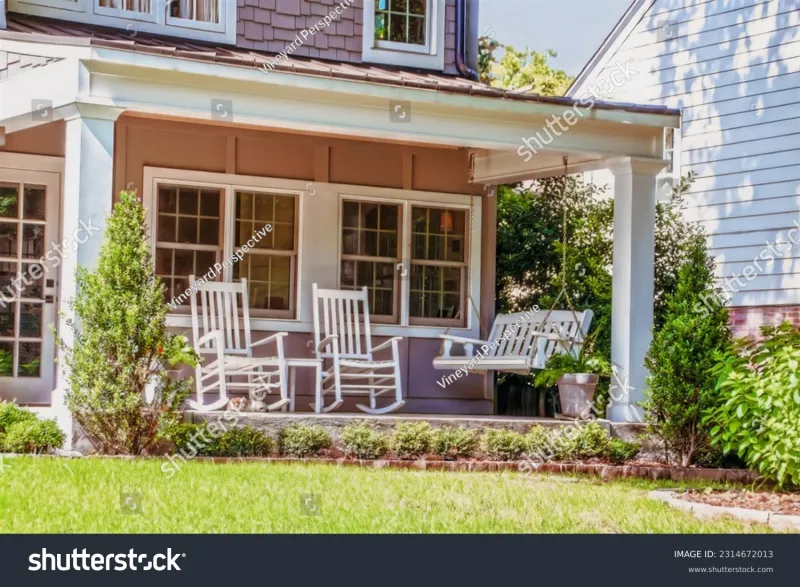
Photo: empty vintage front porch with rocking chairs on american house, via www.shutterstock.com
There's a photo on the wall of my aunt's house in Ohio: a whole street full of people sitting outside in 1962. Not at a party. Just... outside. Lawn chairs, sweet tea, kids zigzagging between legs. Every porch on that block had somebody on it.
Try finding that photo today. You can't, because the scene stopped existing.
The Porch Was Infrastructure
We tend to think of porches as decoration, but they were closer to a public utility. Before air conditioning, the porch was where life happened in the summer. It was cooler outside. It was where you'd catch the breeze, catch up on gossip, and catch the eye of anyone walking by.
More importantly, the porch did something subtle and powerful: it made neighbors visible to each other. You didn't need to schedule a hangout or feel awkward knocking. The porch was a standing invitation. Presence itself was the social contract.
Sociologists have a term for the casual, low-stakes contact that builds trust between strangers: weak ties. Porches manufactured weak ties by the hundreds. And weak ties, it turns out, are what make a neighborhood feel safe and familiar — not the deep friendships, but the hundred small recognitions of a face you know.
Then We Turned Around
The shift didn't happen overnight, but it happened decisively after World War II. Air conditioning made the indoors comfortable. Television made it entertaining. And the new suburban ideal made the backyard — fenced, private, family-only — the center of home life.
The garage started eating the front facade. New builds turned their entryways away from the street. The back patio replaced the front porch, and with it came a philosophical swap: from watching your neighborhood to screening it.
Some of this was understandable. Privacy is a legitimate desire. But we rarely talk about what we gave up. A backyard patio is a private club. A front porch is a commons. One says "my life is in here." The other says "my life is also out here."
Look at a modern subdivision sometime — a row of garage doors, no sidewalks, nobody. That's not an accident. That's architecture making a decision about how we relate to each other, and we all ratified it by moving in.
The Cost of the Turnaround
Here's the uncomfortable part: loneliness rates in America climbed as our houses turned inward. Correlation isn't causation, sure. But when researchers study what makes streets feel safe and residents feel connected, the answers are consistently things porches enabled — passive surveillance, casual greetings, familiarity built through repetition.
The front porch was never going to fix modern loneliness on its own. But its disappearance removed the easiest, lowest-effort mechanism people had for bumping into each other. We replaced ambient community with scheduled community, and then wondered why scheduling felt so exhausting.
Reclaiming It (Without Renovating)
The good news: you don't need a Craftsman-style veranda to get some of this back. You need a chair and a little stubbornness.
- Move your existing setup forward. If you have a front step, a balcony, or even a driveway, put one chair there. Not facing the house — facing the street.
- Do nothing, visibly. The magic of the porch was never an activity. It was being seen. Drink your coffee out front once a week. That's it.
- Wave first. Someone will eventually walk by. The wave costs nothing and resets the terms of the whole street.
- Redefine the front yard. A garden, a little free library, a basketball hoop — anything that pulls life toward the street instead of hiding behind the fence.
- Be the anomaly. Every neighborhood has one house where people sit outside. Every neighborhood also has neighbors who secretly love that house. Be the house.
Sitting Back Down
I bought a cheap adirondack chair last spring and dragged it to my front step, mostly as an experiment. The first week felt strange — like I was loitering on my own property. By the third week, I knew the names of two dogs, one toddler, and roughly when the mail carrier takes her break.
That's not a community. But it's the raw material of one.
The porch didn't die of natural causes. We chose to walk away from it, one backyard fence at a time. Which means we can choose to walk back — one lawn chair at a time.