We Filed a Permit, Borrowed Folding Tables, and Accidentally Made 40 New Friends
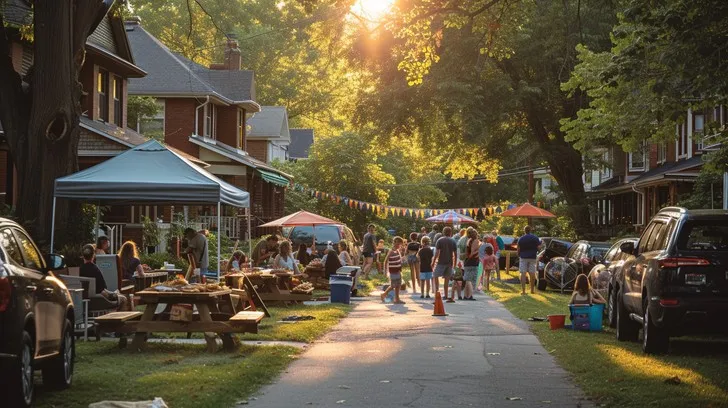
Photo: suburban neighborhood block party folding tables food street gathering, via images.stockcake.com
It started, like most dangerous ideas, with a group text.
My neighbor Priya sent a message to the four households we actually knew on our street: "Has anyone ever heard of a block party? Like, an actual one? With a permit?" Someone replied with a gif. Someone else said their mom used to run them in Cleveland in the '80s. And then, instead of letting the thread die the way every neighborhood group chat dies, Priya said the magic words: "I'll look into it."
Three months later, our street had barricades at both ends, a bounce house, and forty-some people who had lived within 300 feet of each other for years without ever learning each other's last names.
Here's how it happened — and why I think every street in America should try it once.
The Permit Is Easier Than You Think (Mostly)
The single biggest reason block parties die is that nobody wants to be the person who calls City Hall. I get it. Bureaucracy has a way of making a fun idea feel like a tax audit.
But in most mid-sized American cities, the process is genuinely simple: you fill out a form, pay a small fee (ours was $25, sometimes waived for residents), and agree to keep the street accessible for emergency vehicles. Some towns even lend out barricades and traffic cones for free. Ours did. The clerk, a woman named Deb who clearly processed these requests all summer, said something I keep thinking about: "You're the third one this month. Used to be we'd get none."
People are hungry for this. They just need someone to be the nuisance who asks.
Our timeline, for the record:
- 10 weeks out: Applied for the permit, asked about noise ordinances
- 8 weeks out: Posted flyers (yes, paper ones — half our street doesn't use the neighborhood app)
- 6 weeks out: Reserved the city's barricades and a portable fire pit
- 2 weeks out: Started the sign-up sheet for food and chairs
- The night before: Panicked, then borrowed six folding tables from the church down the road
The Potluck Politics Are Real, and Also Fine
Every potluck has its own quiet ecosystem. There's the person who signs up for "main dish" and shows up with a bag of chip-adjacent things. There's the legendary aunt who brings enough biryani to feed a wedding. There's the guy who insists on grilling, at length, with opinions about charcoal.
We had all of them. It was perfect.
The sign-up sheet is the secret weapon. We used a shared spreadsheet with slots for mains, sides, desserts, drinks, and "paper goods." About 60% of households signed up, which was more than enough. The family in the blue house, the one with the aggressive security camera and the invisible owners, showed up with two briskets they'd smoked since 5 a.m. Turns out they'd wanted an excuse to meet people for a decade. They just needed a formal invitation in writing, apparently.
One note: assign someone to bring extra kid-friendly food. Hot dogs and watermelon rescued the under-10 crowd, who spent the entire afternoon treating the bounce house like a demolition derby.
The Strangers Became Friends Somewhere Around Sunset
Here's the thing nobody tells you about suburban life: it's not that people are unfriendly. It's that there is no infrastructure for friendship. We wave. We collect each other's Amazon packages. But wave-based relationships have a hard ceiling.
By 6 p.m., something shifted. The retirees from the corner lot were trading tomato-growing tips with the young couple from the townhomes. A teenager who I'd only ever seen as a hoodie-shaped blur turned out to play jazz trumpet and gave an impromptu concert. Someone's grandmother taught a crowd of kids a card game in Telugu, and they picked it up faster than they pick up their shoes.
When the city's noise ordinance technically kicked in at 9 p.m., nobody left. We just got quieter. Someone brought out a guitar. The last six of us sat in camping chairs in the middle of a street with no cars on it, and it felt — I don't know how else to say this — like the street belonged to us.
The Cultural Argument: Entertainment Got Private, So We Have to Make Community Deliberate
My grandfather's generation didn't need permits to know their neighbors. The front stoop, the church basement, the corner bar, the Friday night football game — these were built-in gathering points. Entertainment was expensive, so it was shared. One TV in the living room meant the whole block showed up for the World Series.
Now every one of us has a 65-inch screen and a streaming queue deep enough to last a lifetime. Private entertainment is cheap and frictionless. Community is expensive and awkward. Guess which one wins by default.
The block party doesn't fix that. But it's a deliberate, one-day rebellion against it. It's saying: for eight hours, the algorithm doesn't get us. The street does.
If You Want to Do This, Steal Our Homework
- Recruit two co-organizers. One enthusiastic person burns out; three people share the weird guilt of nagging neighbors.
- Go door to door in person. The neighborhood app has a 30% reach rate. Knocking gets 90%.
- Keep it free. No tickets, no dues. If someone wants to chip in for the bounce house, fine, but never make money the barrier.
- Plan one activity, minimum. A water balloon toss, a bike parade, a chili contest. Unstructured time is where the magic happens, but structure gets people out of their houses.
- Take photos and share them. Nothing recruits next year's volunteers like a picture of the guy from 4B absolutely dominating the cornhole bracket.
We're already planning next year's. Priya wants a Diwali-meets-October theme. The brisket family is talking about a chili cook-off. The trumpet kid wants to bring his whole jazz band.
Forty strangers, one permit, six borrowed folding tables. Turns out that's all it takes.