Three Hundred Words for a Whole Life: An Afternoon With the Woman Who Writes Our Obituaries
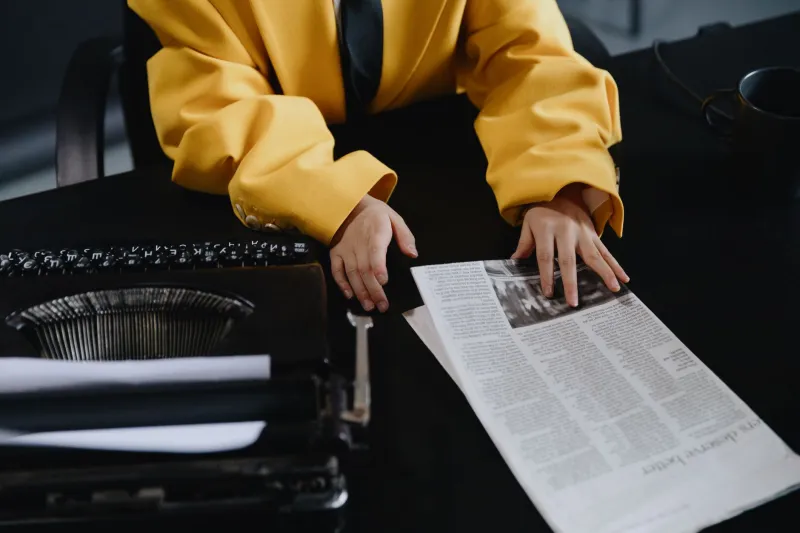
The fax machine at the Cedar County Record still runs on a dedicated phone line, and when it chirps, Dorothy Jean Pruitt stands up from her desk before the first page comes through.
"You learn to move fast," she told me, straightening her cardigan. "Somebody's having the worst day of their life, and I'm the one holding it."
For twenty-two years, Dorothy Jean has written the obituaries for the Record, the twice-weekly paper that covers Cedar County the way a quilt covers a bed — with some patches and a few thin spots. She estimates she's written somewhere north of four thousand of them. She has met, in person, maybe two hundred of the people whose lives she's condensed into three hundred words on newsprint.
The rest, she says, she comes to know the way you know a cousin who lives far away. Through the details their families send in. Through what they choose to mention, and — more telling — what they choose to leave out.
The Fax Is Still the Front Door
The submissions come in every way you can imagine. The fax, yes, but also emails with subject lines in all caps, phone calls from the kitchen landlines of grieving widows, and once, memorably, a handwritten letter from a man who dictated his wife's obituary to his granddaughter two days before his own death and asked that both run the same week.
"They did," Dorothy Jean said. "Side by side. He wrote his own, and it was better than anything I could've done. Said he was 'leaving for an appointment he couldn't reschedule.' His boys laughed at the funeral. First time in a week."
She keeps that letter in her bottom drawer, along with a few others she can't part with. There's the one from the woman who listed her late husband's survivors as "his dog, Biscuit, who will not understand." The one from the daughter who admitted, in the final line, that she and her mother hadn't spoken in nine years and that the obituary was "the longest conversation we ever finished."
That's the thing nobody tells you about obituaries: for a lot of families, it's the last project they'll ever complete together. Siblings who haven't shared a document since their parents' divorce will trade drafts at 2 a.m. Estranged cousins will weigh in on whether to include the second wife. Everyone has an opinion on the photo.
"It's the last thing they'll ever do together," Dorothy Jean said. "And they know it. So they fight about it, and they cry about it, and then they get it right. Almost always, they get it right."
What Three Hundred Words Can Hold
Ask her what she's learned after four thousand lives, and she doesn't hesitate.
"Nobody wishes they'd worked more Saturdays. That's not in the copy. Not once, not ever, has a family sent me 'he never missed a day of work in forty years' as the lead. It might be in there somewhere, down in paragraph three. But it's never the thing."
The thing, she says, is almost always small. The Sunday pancakes. The way he waved at the school bus every morning until the driver started honking back. Forty-one years of the same church pew, third from the front. A woman who taught half the county to drive and never once yelled when a student stalled at the light on Highway 34.
"Families think they need to tell me the résumé," she said. "What I need is the pancake. Give me the pancake and I can write you a person."
She has rules, developed over two decades and never written down until now: Never open with the disease. Always use the full name once, then the name everybody used. If the family says "he was ornery," that means he was beloved. If they say "she never met a stranger," she met plenty, and she handled them. And if the submission says "no services planned," call the family anyway, gently, because about half the time somebody needs permission to plan one.
The Strangest Kind of Intimacy
There's a particular loneliness to the work, Dorothy Jean admits. She writes love letters, in a sense, to people she'll never shake hands with. She knows the shape of their lives but not the sound of their voices.
"I've written about a man's fifty years at the co-op, his tour in Korea, his tomato garden that won the state fair twice — and I couldn't pick him out of a lineup at the feed store," she said. "But his grandkids read that obituary at the visitation, and they cried, and they said 'that's Grandpa.' So I guess I got close enough."
Sometimes the closeness goes the other way. Twice a year or so, someone stops her at the grocery store — she lives in the county seat, everyone stops everyone — to say their family still has her clipping on the fridge. "One woman told me she reads her mother's obituary every Sunday morning with her coffee. Twenty years running. I wrote that in an afternoon. You don't get over knowing that."
Still on Deadline
Dorothy Jean is seventy-three now, and the paper has offered to hand the beat to someone younger. She's declined, politely, three times. The fax line, she points out, is in her name.
"I'll do it till they carry me in," she said, laughing, then corrected herself — a habit, I suspect, of a lifetime of writing around death with more tenderness than fear. "I'll do it as long as the faxes keep coming. And they keep coming."
Before I left, I asked what she'd want in her own obituary. She waved the question off, then circled back to it as I was pulling on my coat.
"Just say I paid attention," she said. "That's the whole job. Somebody hands you a life in a paragraph, and you pay attention to it."
Then the fax chirped, and she stood up before the first page came through.