Losers Stitch Up: Eight Years of Showing Up to a Game That Never Officially Exists
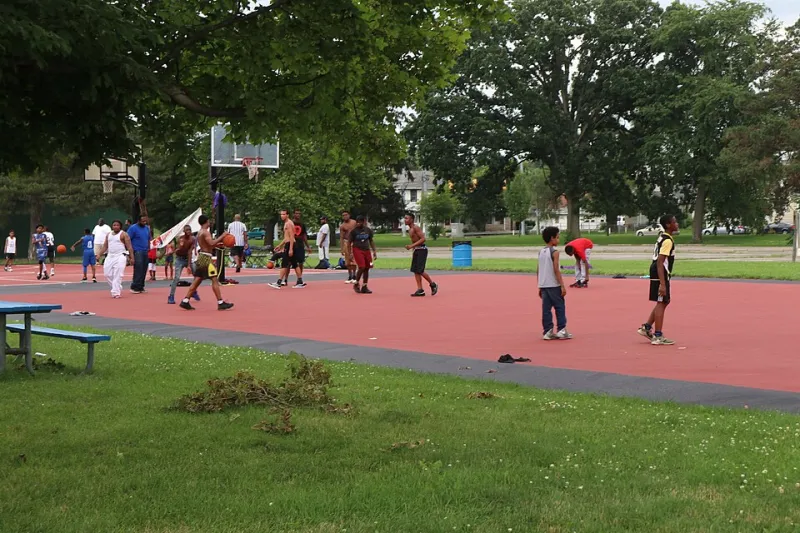
Photo: City of Indianapolis | Mayor's Office from Indianapolis, IN, Public domain, via Wikimedia Commons
The first rule of the Saturday game at the downtown YMCA is that nobody explains the rules. You learn them the way I did — by violating one and feeling the whole court go quiet for a beat longer than feels comfortable.
Mine was calling my own fouls too eagerly. Sounds polite, right? Wrong. Calling a foul on your own shot in this gym reads as a power grab, a lawyer move. You shake it off, play on, and earn your reputation back one possession at a time. That's how it works here. Nothing is written down. Everything is understood.
The Game With No Founder
Ask anyone in the gym when this started and you'll get a shrug, a guess, or a story about a guy named Marcus who may or may not have ever existed. The best estimate comes from Dave, a 58-year-old HVAC contractor who's been coming since before the Y renovated the lobby. "Eight years, give or take," he told me between gasps at the free-throw line. "Before that there was a different game, but it fizzled."
That's the thing about pickup basketball — it has no birth certificate. No one registered it, no one scheduled it, no one is in charge. And yet it has outlasted the church rec league that folded in 2019, the app-based pickup group that required everyone to verify their skill level (it died in six weeks), and at least two attempts to formalize things with team shirts.
The shirts killed it both times. The moment someone assigns you a jersey, it stops being a game and starts being a commitment.
The Cast
Every Saturday between 9 and 9:20 a.m., the same ecosystem reassembles itself. There's Dave, obviously, who plays point guard like a man defusing a bomb — slow, deliberate, occasionally brilliant. There's the college kid whose name we've never learned but whom everyone calls "Big Fresh." There's Priya, a nurse working night shifts who shows up twice a month and scores fifteen points like she never left. There's a rotating bench of guys training for police and fire exams, a middle school teacher who talks trash exclusively in movie quotes, and, for the past year, a retired mail carrier named Otis who is 71 and will absolutely back you down.
Nobody recruited these people. They just showed up, which is the only membership requirement that has ever mattered.
The Unwritten Constitution
Spend enough Saturdays on that court and you can draft the bylaws nobody wrote:
Winners stay, losers rotate. Games to 11, straight ones. Winner's ball. If more than ten guys are waiting, games drop to 9. If it's beautiful outside and half the gym is missing, we play to 15 and nobody keeps score honestly.
Losers stitch up. The losing team runs one lap or does ten push-ups while the winners shoot. This is non-negotiable and has nothing to do with fitness. It's a punctuation mark. It says: this game ended, the next one begins.
You guard the guy who arrived when you did. There's an invisible matchmaking system based purely on order of entry. Violate it and you'll find yourself guarding Otis, and Otis will make you regret every life choice that led you there.
Nobody screens Big Fresh from behind. He's 6'8" and 19. We'd like him to keep his knees.
The last game of the day belongs to everyone. No matter the score, everyone on the floor plays the final game. It's how the shy kid who's been hovering by the water fountain for three Saturdays finally gets his run.
Why It Survives When Everything Else Doesn't
I've watched a lot of organized belonging die in the last decade. Softball leagues that couldn't hit roster minimums. A book club that required a shared Google Calendar and collapsed under the weight of rescheduling. A neighborhood watch that turned into a neighborhood argument.
The Saturday game endures for a reason I didn't fully understand until I'd been coming for a season: it demands almost nothing and offers almost everything. You owe the court nothing but the next two hours. Miss three weeks for a work trip or a newborn and nobody sends a passive-aggressive text. You just show back up, get matched with whoever arrived when you did, and play.
Sociologists have a term for this — "third place," the spaces that aren't home or work where community actually happens. But the term feels too clinical for what happens when Dave throws a no-look pass to a stranger and the stranger, for one afternoon, isn't a stranger anymore.
Belonging Without the Paperwork
Here's what eight years of Saturday mornings has produced, invisibly, without a single meeting minutes document: a guy from the court helped another guy from the court move a piano. When Priya's hospital needed plasma donors, four of us drove across town. When Big Fresh's family hit a rough patch financially, an envelope appeared in his gym bag that nobody claims to know anything about.
None of this was organized. All of it was organized. That's the paradox of the pickup game — it's the loosest possible human arrangement, and yet it produces the kind of loyalty that formal groups spend thousands of dollars on retreats trying to manufacture.
I used to think commitment was the price of community. Sign up, pay dues, attend meetings, earn your belonging. The Saturday game taught me the opposite: sometimes community is what grows in the exact spaces where nobody's asking you to commit to anything.
The court closes at noon. By 12:15 on Saturdays, the gym is empty, the lights humming over scuffed hardwood, no evidence that forty small acts of trust just took place. Next week, we'll do it again. Nobody will announce it. Nobody has to.
Losers stitch up. Winners stay. And the game that never officially exists goes on.